Why Rural Transport Needs a Network Revolution
A new peer-reviewed paper by Fika’s Brooke Segerberg and Abbie Noriega, published this week in Sustainability, makes a compelling case for rethinking how the world plans rural transport infrastructure.
The problem
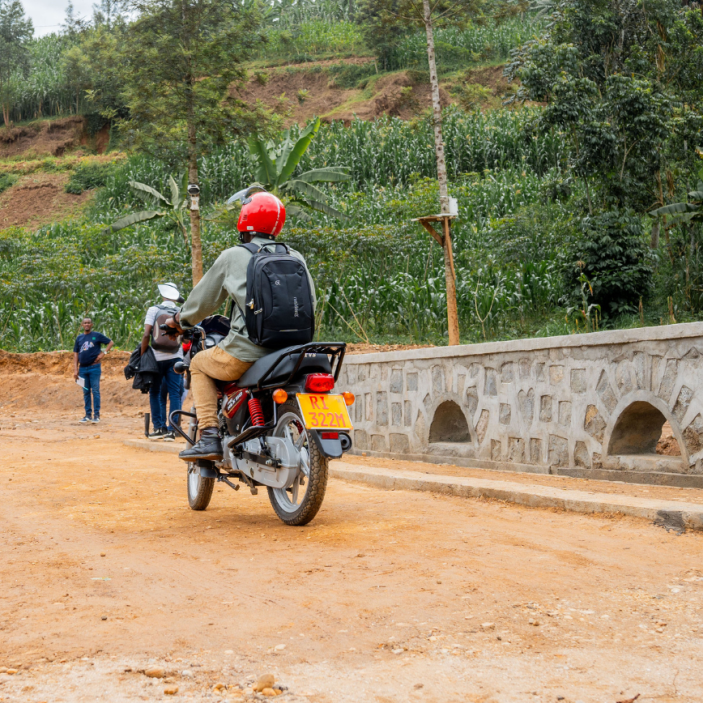
Most rural transport planning focuses on roads. But in much of rural Africa, over 80% of trips are made on foot, by bicycle, or by motorcycle. Footpaths, trails, water crossings, and informal tracks are the connections rural communities depend on daily, yet they’re almost entirely absent from formal planning and investment frameworks.
The paper argues that rural transport should be understood as an interconnected network rather than a collection of isolated assets. When a footpath is missing, or a seasonal crossing becomes impassable, the whole system fails, including the higher-order roads further up the chain.
The blind spots
The problem is compounded by tools that systematically undercount rural people and undervalue rural access. Global population datasets may underestimate rural populations by 32–77%. The primary global connectivity metric, the Rural Access Index, measures distance “as the crow flies,” ignoring terrain, rivers, and seasonality. And conventional cost-benefit frameworks struggle to capture what it actually means to connect a community to a clinic or a school.
What works
The paper points to three approaches that consistently deliver: participatory planning that captures how communities actually move; travel-time modeling that accounts for terrain and seasonality; and cross-sectoral integration that links transport investment to health, education, and agriculture outcomes.
The UN Decade of Sustainable Transport (2026–2035) offers a critical window to get this right. Fika’s work building bridges, gathering mobility data, and now contributing to the academic literature sits at the center of that effort.
